

Infrared LED wristbands receive commands through invisible light, then use visible LEDs to show the requested effect. Reliable control depends on the signal arriving in a form the receiver can recognize. This Longstar technical analysis examines the electronics and optical design behind that response.
Wavelength and carrier frequency do different jobs
An infrared wavelength describes the light itself; the carrier frequency describes how quickly the transmitter pulses it. A 940 nm emitter and a 38 kHz carrier are common examples in IR remote control, not specifications for every wristband.
In a typical modulated IR design, the receiver filters and demodulates the signal before a microcontroller decodes it. Matching the carrier alone doesn’t establish compatibility. Burst lengths and gaps must suit the receiver, while the command format must match the firmware. Two products labelled “infrared” may still use incompatible instructions.
Noise rejection has a tradeoff
Automatic gain control, or AGC, helps an IR receiver suppress unwanted signals. Receiver selection involves a balance: stronger noise suppression can reduce compatibility with some data formats. A command repeated too frequently may fall outside the receiver’s permitted burst pattern.
Sunlight and some lamps can add optical noise. Their effect depends on the receiver and lighting conditions. So a dark-room demonstration cannot establish reception under direct daylight. Increasing transmitter power alone won’t resolve a mismatch in coding or timing.
The housing is part of the optical path
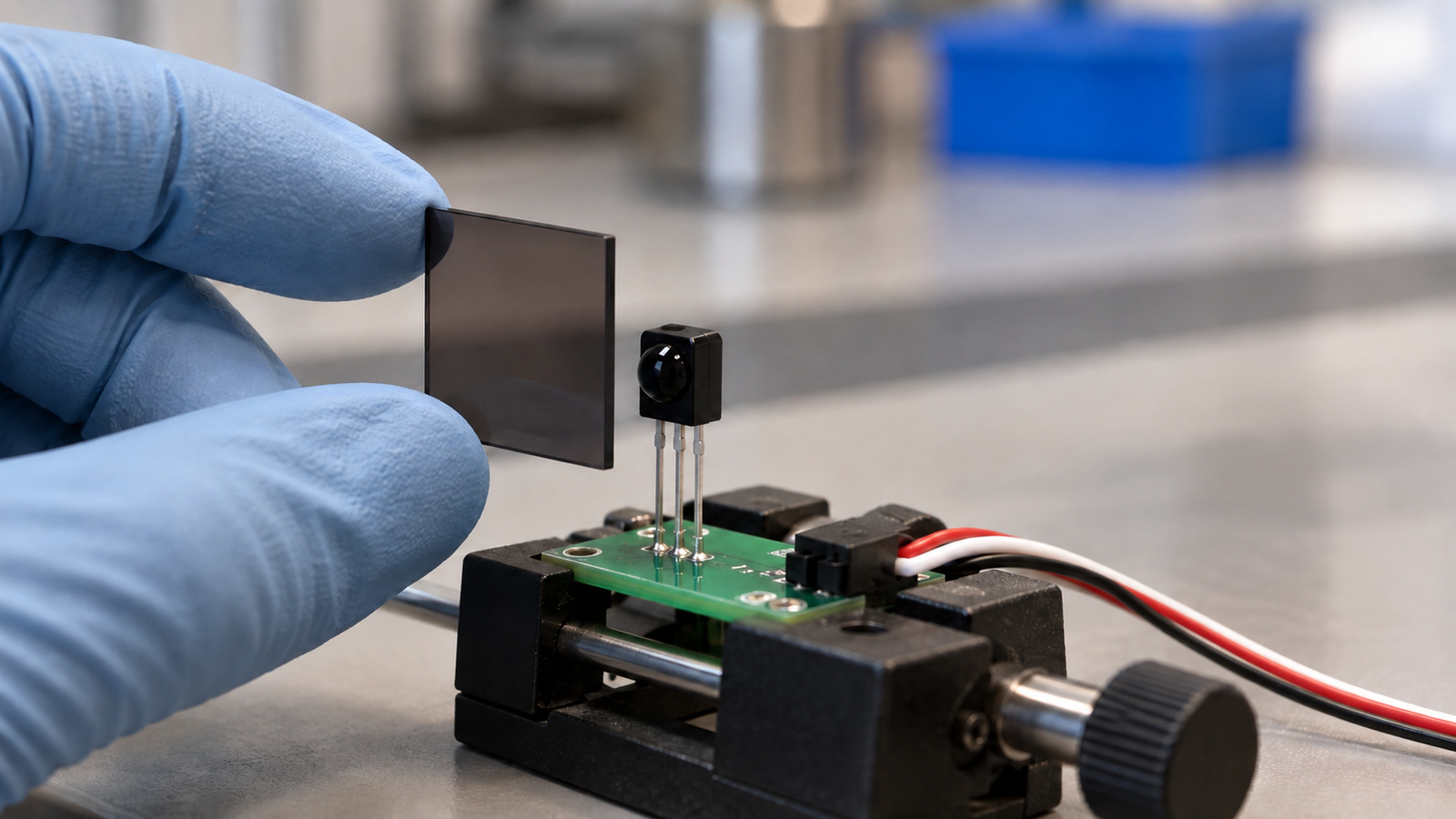
The receiver needs a window that transmits the intended infrared wavelength. Visible appearance doesn’t establish that property. Material and wall thickness affect transmission, while a small opening or a receiver recessed too far behind it can restrict the receiving angle.
For a custom wristband, check the finished housing with its final decoration. Artwork or an opaque coating over the receiving window can change the signal path. A bare circuit board responding on the bench leaves this part of the design untested.
Coverage must allow for a moving wrist
A turned wrist or a sleeve covering the receiving window can interrupt the direct optical path. Reflected infrared may help indoors, but reception depends on the surfaces and geometry. A range measured in a reflective corridor won’t transfer unchanged to an open venue.
Test representative wrist positions across the intended area with the actual lighting operating. Record where commands are missed, then assess transmitter placement or receiver exposure. A coverage claim needs its test conditions.
Longstar supports OEM and ODM development of custom LED event products. For an infrared project, the technical brief should connect the command format to the receiver and finished housing, then define the intended operating conditions. That gives the design discussion a basis beyond LED brightness.
References
Vishay — General Overview of IR Transmission in Free Ambient (23 August 2021)
Vishay — Application Overview (13 June 2024)
Vishay — TSOP122 and Related IR Receiver Modules (23 May 2025)
Vishay — Mechanical Design Notes (6 September 2017)
Post time: Oct-28-2026


